
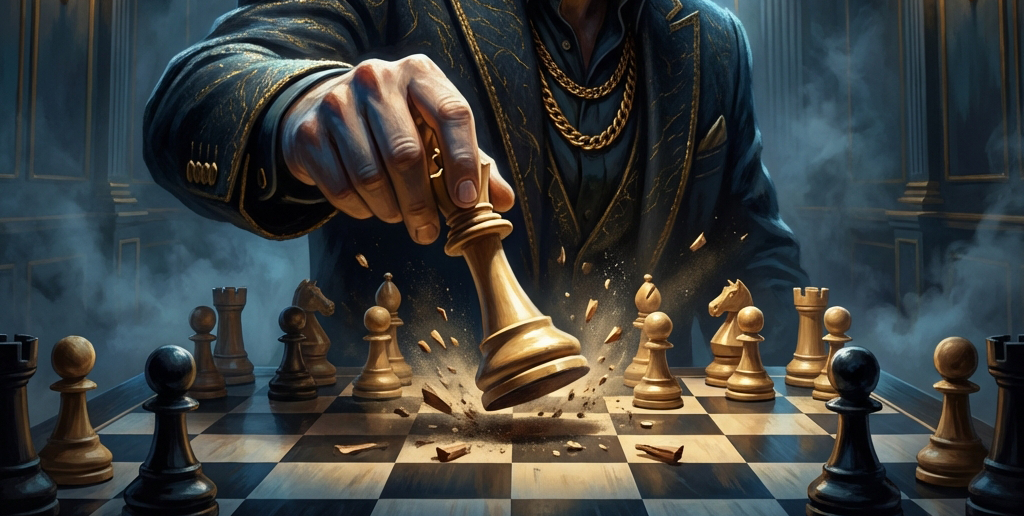
Chess is a silent battlefield. For centuries, the only sounds were the tick of a clock, the slide of a piece, and the soft thud of a captured soldier hitting the box. But within this quiet arena, a different kind of war has always raged—a war of psychology, presence, and pure, unadulterated swagger.
Long before "trash talk" entered the lexicon, masters of the game understood that victory could be secured not just through superior calculation, but by getting inside an opponent's head. Today, in the era of streaming and esports, the celebration has become a public spectacle. Let's trace the evolution of chess swagger, from the intimidating legends of the past to the viral moments of the present.
Part 1: The Classic Era - Intimidation as High Art
Before livestreams and instant GIFs, swagger was a slow, subtle burn. It was about creating an aura of invincibility.
The Fischer Glare: Weaponizing Intensity
Bobby Fischer didn't just play chess; he waged psychological war. His most famous weapon was The Stare. After making a move, Fischer wouldn't retreat to his chair. He'd stand, walk to the edge of the stage, and fix his opponent with an unblinking, hawk-like glare for minutes on end.
The message was primal and brutal: "I am here. I am watching you. You are alone with your mistake."
This wasn't celebration; it was a relentless, pre-victory assault on concentration. Against Boris Spassky in their 1972 World Championship match, this unnerving ritual became as famous as the moves themselves, breaking Spassky's composure as effectively as any sacrifice.
The Kasparov Scowl: The Tempest of Will
Garry Kasparov brought a different energy—raw, volcanic, and dominant. His swagger was in his physicality. The hunched, prowling posture over the board. The furious, impatient scribble of scoresheet notation. The scowl of utter contempt for a weak move.
Kasparov's entire demeanor screamed, "How dare you challenge me with such mediocrity?" He celebrated not with a gesture, but with the sheer force of his will, creating an atmosphere where opponents felt they were not just losing a game, but being physically overwhelmed by a superior intellect.
Part 2: The Digital Dawn - Swagger Goes Public
The rise of online chess and broadcasting changed everything. Swagger was no longer confined to the opponent across the board; it was performed for an audience of millions.
The "Bullet King" Brag: Nakamura and the Mic Drop
Hikaru Nakamura, the king of online speed chess, pioneered the digital celebration. In bullet (1-minute) games, there's no time for a slow stare. The swagger happens after the checkmate. A simple, cold "gg" (good game) in the chat as the opponent's clock ticks to zero.
Or, more famously, the queen sac into smothered mate when up massive material—a move that says, "I'm not just winning; I'm winning with style so beautiful it humiliates you." It's a pure, efficient flex for the streaming generation: victory as content.
The Botez Blunder & the Resilient Smile
When Alexandra Botez famously hung her queen on stream, she didn't rage-quit. She created an icon. The facepalm, the shocked laugh, the immediate self-deprecation—it was a new kind of swagger: the swagger of resilience. By owning the blunder with humor and grace, she turned a moment of failure into a relatable, human brand.
Part 3: The Modern Arena - Celebration as Signature
Today, every top player has a signature.
The Carlsen Stillness: The Power of the Poker Face
In many ways, Magnus Carlsen is the anti-celebrator. His ultimate swagger is the absence of it. The blank, impassive face. The slow, deliberate walk away from the board after a crushing move. The refusal to show any emotion, good or bad. This unnerving calm is a psychological fortress. It gives the opponent nothing—no tells, no frustration to feed off, no joy to deflate.
The Firouzja Fist Pump: Raw Emotion Unleashed
Alireza Firouzja represents the new generation's unfiltered passion. His celebrations are athletic, visceral: the clenched fist pump, the leap from the chair, the roar of triumph. It's the celebration of the prodigy who has just slain a giant, a burst of pure, youthful joy and ambition.
The Psychology Behind the Pose
Why does this matter? Because chess, at its highest level, is a contest of nerves as much as neurons.
- Intimidation seeks to induce doubt and fear, shortening an opponent's calculation and prompting mistakes.
- Unflappability (like Carlsen's) aims to frustrate, making opponents feel they cannot land a psychological blow.
- Joyful Confidence (like Firouzja's) can be energizing for the celebrant and demoralizing for an opponent who feels their best effort is being casually dismissed.
The celebration is the final, unspoken move of the game. It frames the narrative of victory and defeat.
What's your favorite piece of chess swagger? Is it the icy stare, the resilient laugh, or the silent nod of a champion? Share your iconic celebration moment in our community!