
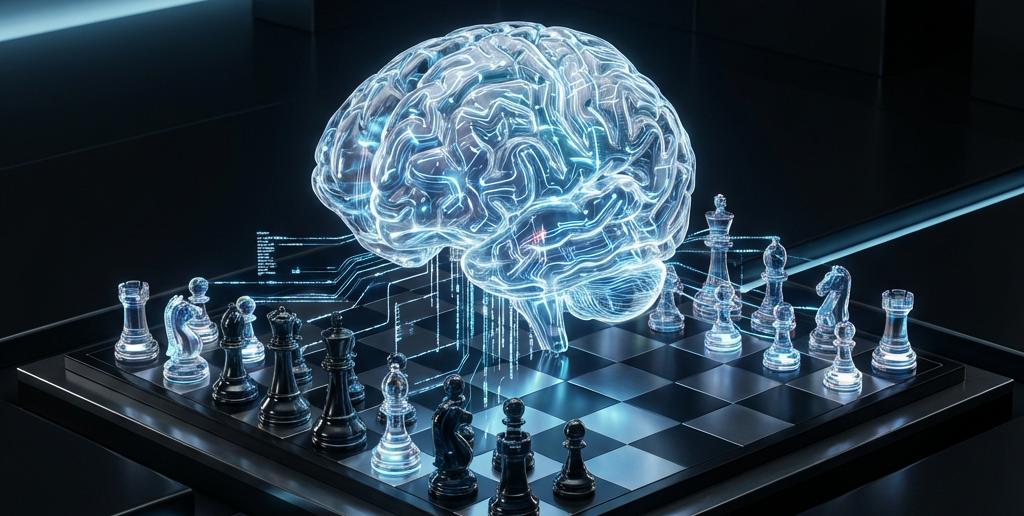
When you think of chess, what comes to mind? Grandmasters in deep thought, intense tournaments, perhaps the cool, calculating mind of a champion like Magnus Carlsen.
But what if I told you that every time you move a pawn or plan a fork, you're not just playing a game—you're giving your brain a full-scale workout? While most people know chess "is good for your brain," the specific cognitive benefits are far more profound and practical than you might realize.
Let's move beyond the clichés and explore five unexpected ways chess trains your mind for success, both on and off the 64 squares.
1. The "Oh No!" Moment: Training Your Brain for Emotional Recovery
We've all been there. You hang a queen. You blunder a mate in one. The immediate rush of frustration, even shame, is visceral. This is where chess becomes a masterclass in emotional regulation.
What's happening in your brain: The amygdala, your brain's alarm system, fires up in response to the perceived threat. Chess forces you to consciously engage your prefrontal cortex—the rational, planning center—to override this panic.
2. Seeing the Matrix: Developing "Pattern Literacy"
Grandmasters don't just see pieces; they see structures, motifs, and flows of energy. They recognize a "Smothered Mate" setup because they've internalized these patterns. This skill is called pattern recognition, but it's more useful to think of it as "Pattern Literacy."
What's happening in your brain: Your brain is a pattern-making machine. With repeated exposure, it chunks information into a single, recognizable unit. This is why a strong player can glance at a position and instantly sense the correct plan.
3. The 10-Move Sacrifice: Mastering Delayed Gratification
In a world of instant likes and one-click purchases, chess is an antidote. The most beautiful combinations often begin with a quiet move or a material sacrifice whose reward is many turns away.
What's happening in your brain: You're strengthening the neural pathways between your goal-oriented prefrontal cortex and the reward-seeking ventral striatum. You're literally practicing the act of choosing a larger, later reward over a smaller, immediate one.
4. Holding the Whole Universe: Boosting Working Memory
Close your eyes and visualize the board. Now, think three moves ahead for both sides. You're holding multiple pieces of dynamic information in your head simultaneously. This is a brutal workout for your working memory.
What's happening in your brain: Your brain's "sketchpad," primarily in the dorsolateral prefrontal cortex, is firing on all cylinders. Studies using fMRI scans show that during calculation, chess players' brains light up like a Christmas tree.
5. The Opponent's Shoes: Cultivating Cognitive Empathy
To win at chess, you must get inside your opponent's head. You ask: What are they planning? What do they fear? This practice of modeling another person's mind is known as Theory of Mind.
What's happening in your brain: You're suppressing your own perspective to simulate the mental state of another. This engages a network involving the temporoparietal junction—the same circuitry used when we understand others' intentions in daily life.
Conclusion
Chess is more than just a game; it's a metabolic and cognitive investment. Whether you're a casual player or a serious competitor, every game you play is sharpening these vital mental tools that serve you in every aspect of life.