
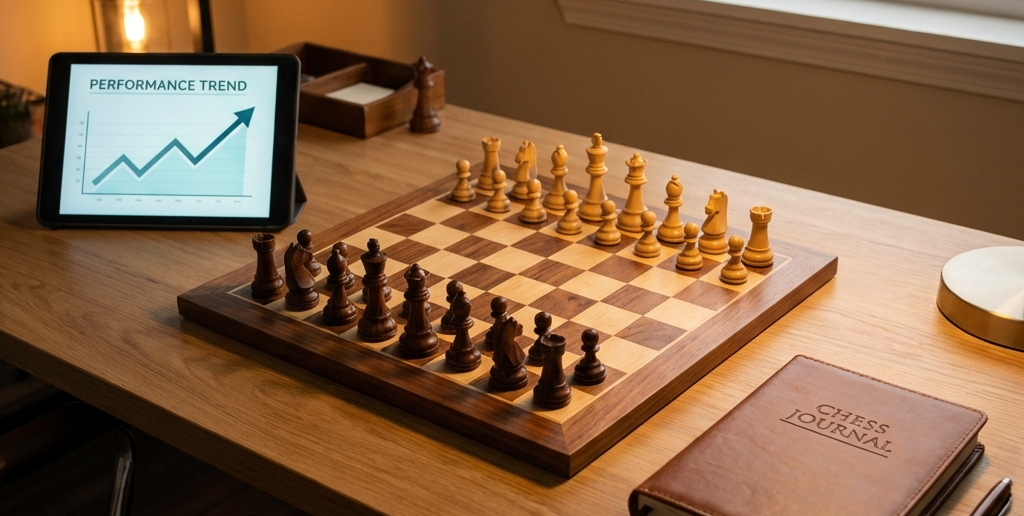
You know the feeling. You browse a chess forum, watch a lesson on YouTube, solve a few random puzzles, play a dozen blitz games, and then"¦ nothing. Your rating graph looks like a flatline with a few hopeful spikes that always crash back down.
Why? Because random practice leads to random results.
Real, lasting improvement in chess isn't about consuming more content. It's about structured, deliberate practice. It's the difference between kicking a soccer ball around in the backyard and showing up to team practice with a coach, a plan, and specific drills.
This guide will help you move from a "chess hobbyist" to a "chess improver." Let's build a routine that fits your life and actually moves the needle.
Step 1: The Diagnostic – What's REALLY Holding You Back?
You can't fix what you don't measure. Before you plan a single study session, you must conduct an honest audit. Don't guess—use data.
- Opening Disaster: Lost/way worse by move 15.
- Middlegame Muddle: Was okay out of the opening, but got outplanned or missed a strategic idea.
- Tactical Collapse: Hung a piece, missed a fork, or got mated.
- Endgame Erosion: Reached an equal endgame and slowly lost it.
- Time Trouble: Lost on time or made blunders due to clock pressure.
Your Result: You'll likely see a clear pattern—e.g., "60% of my losses are Tactical Collapses." This is your improvement priority #1. Focus your routine here.
Step 2: The Pillars of a Balanced Routine
Think of your chess strength as a table with four legs. If one is short, the whole thing wobbles. Your weekly routine should touch on all four pillars.
Pillar 1: Tactics (The "Weightlifting" Session)
Goal: Sharpen pattern recognition and calculation.
Right Way (Deliberate Practice):
- Themed Sets: Focus on one motif for a week (pins, forks, etc.).
- Calculate to the End: Don't move until you've visualized the entire sequence.
- Quality over Quantity: 10-15 deeply calculated puzzles are worth more than 100 guesses.
Pillar 2: Structured Study (The "Classroom" Session)
Goal: Build knowledge and strategic understanding.
Right Way (Active Learning):
- Choose ONE Topic: Focus on things like "Weak Squares" or "Rook Endgames."
- Use a Board: Set up the positions yourself. Play out the variations.
- Take Notes: Write down the 3 key principles you learned.
Pillar 3: Purposeful Play (The "Scrimmage" Session)
Goal: Apply your skills under pressure.
Right Way:
- Play Slower Games: Rapid (10+5 min) or Classical is better for improvement.
- Set a Pre-Game Goal: E.g., "I will focus on the opening I studied this week."
- Limit Volume: 2-3 serious games are better than 20 autopilot games.
Pillar 4: Analysis & Reflection (The "Film Review" Session)
Goal: Close the feedback loop and learn from mistakes.
Right Way:
- Analyze Without an Engine First: Identify critical moments and plans.
- Use the Engine as a Fact-Checker: Only after your own analysis.
- Extract ONE Lesson: Add this to a "My Mistakes" document.
Step 3: Build Your Weekly Schedule
Now, let's fit these pillars into a real life. Choose a template that fits your budget.
Template A: The "Time-Crunched Improver" (3-4 hrs/week)
- Mon: Tactics (30m) + 1 Rapid Game (45m).
- Tue: Analysis of Mon game (30m).
- Wed: Tactics (30m).
- Thu: Structured Study (45m).
- Sat: 1-2 Rapid Games (60-90m).
- Sun: Analysis of Sat game(s) (30-45m).
Template B: The "Serious Student" (6-8 hrs/week)
- Mon: Tactics (45m) + Structured Study (60m).
- Tue: 2 Rapid Games (90m).
- Wed: Analysis (60m) + Tactics (30m).
- Thu: Structured Study (60m).
- Fri: 1 Rapid Game (45m) + Fun Blitz (30m).
- Sat/Sun: Analysis + Long Study Deep Dive.
Step 4: The Critical Habits for Long-Term Success
- Keep a "Chess Journal": Log goals, takeaways, and principles. Review weekly.
- Embrace the "Offline Board": Use a physical board for at least 20% of study time.
- Define "Fun" Practice: Schedule guilt-free casual chess to prevent burnout.
- Set Process Goals: Focus on doing the routine, not just reaching a rating.
"The final move: Consistency beats intensity. A Managed 4-hour week for a year will transform you more than one perfect 10-hour week."