
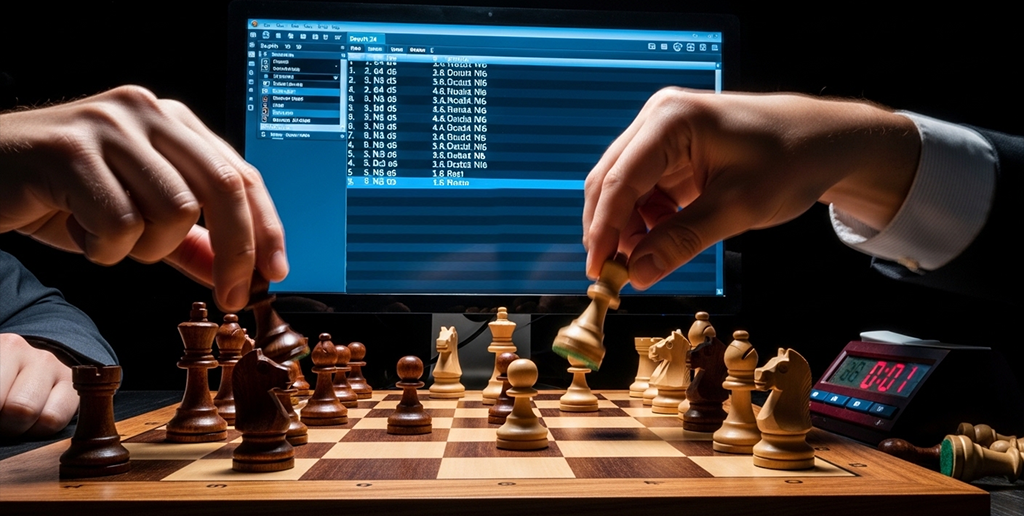
Chess improvement is all about learning from your games. But are you learning the right lessons?
There's a habit that almost every chess player falls into at some point. You've just finished a bullet game — 1 minute on the clock, your heart still racing, fingers still twitching — and you open up your engine. You crank the depth up to 24, maybe even higher, and start going through your moves.
The engine lights up red. Mistakes everywhere. Blunders you didn't even know you made. You spend the next 20 minutes trying to understand why sacrificing the bishop on move 18 was wrong, staring at lines that go 15 moves deep.
Sound familiar?
Here's the hard truth: you're not improving. You're just feeling productive.
Analyzing bullet games with a high-depth engine is one of the most common — and most misunderstood — habits in amateur chess improvement. In this article, we're going to break down exactly why this approach doesn't work, what you should do instead, and how to actually get better by learning from your fast games.
What Does "Depth 24" Actually Mean?
Before we get into why it's a problem, let's quickly talk about what engine depth actually means.
When a chess engine like Stockfish analyzes a position, it searches through possible moves like a tree — your move, opponent's response, your response to that, and so on. Depth refers to how many half-moves (called "plies") ahead the engine looks. Depth 24 means the engine is looking 24 half-moves into the future — that's 12 full moves of chess.
At depth 24, Stockfish is playing at a level that no human being on earth can match. It sees tactical combinations that span 10+ moves. It evaluates positional nuances that take grandmasters years of study to recognize. It's essentially seeing a version of chess that exists in a completely different dimension from what you or I are playing.
That's fine for analyzing a classical game where both players had time to think. But for a bullet game? It's almost completely useless — and here's why.
The Fundamental Problem: Bullet Chess Is Not "Real" Chess
Let's be honest about what bullet chess actually is.
In a 1-minute game, you have, on average, about one second per move. Sometimes less. You're not calculating. You're not evaluating. You're reacting, pattern-matching, and trusting your instincts. Your hands are moving almost before your brain has finished thinking.
Bullet chess is closer to a reflex sport than it is to the slow, methodical game of classical chess. And that's not an insult — there's real skill involved in bullet. Speed, intuition, flag-hunting, and time pressure management are all legitimate skills. But they're different skills from what classical chess rewards.
So when you take a bullet game and run it through a depth-24 engine, you're applying the standards of one game to evaluate the performance in a completely different game. It's like analyzing a 100-meter sprint using the biomechanical standards of a marathon runner. The metrics just don't match.
Your Mistakes Are Not Really Your Mistakes
Here's something that might reframe how you think about your bullet games entirely.
When you blunder a piece on move 15 of a bullet game, was it really a chess mistake? Or was it a time management mistake? A finger slip? A failure of intuition under extreme pressure?
The engine at depth 24 doesn't know the difference. It just sees that you played Bd3 instead of the objectively correct Nf4, and it slaps a red mark on your move. What it can't tell you is:
- You had 4 seconds left on the clock
- You'd already seen a better move but couldn't execute it in time
- You misclicked because your hand was shaking
- You were deliberately playing fast to put pressure on your opponent
High-depth engine analysis treats every bullet move as a deliberate, calculated decision. But most of them aren't. When you spend 20 minutes trying to understand why your "mistake" was wrong, you're often studying a position that was never really about chess at all — it was about time pressure, and no engine analysis will ever teach you how to handle that.
The Cognitive Load Problem
Even in the positions where you genuinely did have time to think, depth-24 analysis creates another problem: the moves it shows you are often impossible for a human to find over the board.
Let's say you were in a sharp tactical position and you played an inaccuracy. The engine points to a sequence like: Rxf6, gxf6, Qh5, Kf8, Nd5, exd5, Bg6 — and calls it winning.
Can you actually use that information to improve?
For most club-level players — even experienced ones — the answer is no. You can understand that the line is winning once the engine shows it to you. But seeing it yourself, in real-time, in a bullet game? That's not realistic. And trying to memorize these deep tactical sequences rarely transfers to your actual play.
What happens instead is a kind of analysis paralysis. You get overwhelmed by variations you can never realistically play, start doubting your instincts, and end up playing worse — not better.
What You Should Do Instead
Okay, so high-depth bullet analysis is out. That doesn't mean you shouldn't look at your games at all. Here's a smarter approach.
1. Use Lower Engine Depth (Depth 12–16)
When you do use an engine to check bullet games, drop the depth significantly. Depth 12–16 is usually more than enough to identify genuine blunders and tactical oversights. At this depth, the engine is still playing far stronger than most humans, but it's more likely to point you toward ideas that are actually reachable — moves you could realistically find with a bit more time.
2. Focus on Pattern Recognition, Not Deep Lines
The real value in reviewing bullet games isn't in finding the "objectively best" move — it's in identifying patterns. Ask yourself: Did I miss a fork or pin that I should have seen? Did I fail to see a basic back-rank threat? Did I repeatedly mishandle a specific type of position? These are things that will actually improve your bullet play, because they show up over and over again in fast games.
3. Annotate Before You Analyze
Before opening the engine, spend a minute going through the game yourself. Try to remember what you were thinking at key moments. Mark the positions where you felt uncertain or where you knew you were making a guess. Then, when you look at the engine, focus only on those moments. You'll learn more from deeply understanding two or three key positions than from getting a surface-level verdict on every single move.
4. Study Classical Games to Improve Bullet
Here's a counterintuitive truth: the best way to improve your bullet chess is often not to analyze your bullet games at all — it's to study classical games deeply. When you study master-level classical games, you're internalizing patterns, ideas, and plans that eventually become instinct. The openings become automatic. The endgame techniques become reflexes. Bullet improvement is a downstream effect of overall chess improvement.
5. Use Lichess or Chess.com Analysis for Quick Feedback
Both Lichess and Chess.com have built-in game analysis tools designed for quick review rather than deep study. Lichess in particular uses Stockfish but presents the analysis in a way optimized for learning — highlighting only the most significant mistakes, giving a simple accuracy percentage, and pointing you toward critical positions without burying you in variations. These tools are a much more efficient way to review a bullet game.
The Emotional Side of High-Depth Analysis
There's something else going on when you over-analyze bullet games with a powerful engine — and it's worth naming.
For a lot of players, high-depth analysis is a form of self-criticism. You're looking for every mistake, cataloging every error, holding yourself to an impossible standard. And when you see 15 red moves in a row, it feels demoralizing. You think "I'm so bad at chess" — but what you're actually seeing is the gap between a 1-second decision and a depth-24 supercomputer. That gap isn't a reflection of your chess ability. It's just physics.
There's also a psychological trap called "engine blindness" that long-term heavy engine users develop. After spending hundreds of hours watching engines evaluate positions, you start to lose trust in your own chess intuition. You second-guess moves that are actually fine. You stop trusting your pattern recognition and start waiting for the engine to validate every idea.
This is especially damaging for bullet chess, which requires you to trust your instincts. If you've trained yourself to doubt your own judgment, you'll hesitate at exactly the moments you need to move fast.
When Is Deep Engine Analysis Actually Useful?
To be fair, there are absolutely times when depth-24 (or even higher) engine analysis is exactly what you should be doing.
If you're studying a classical or rapid game where you spent significant time thinking on key moves, deep analysis makes sense. You want to know whether your calculations were correct, whether you missed something important, and whether the plans you chose were objectively sound.
Similarly, if you're preparing opening theory or studying an endgame position, going very deep with an engine is valuable and appropriate. The engine is functioning as a teaching tool, not as a scorekeeper for your intuitive play.
The key distinction is this: deep engine analysis is useful when the game was played with enough time for human calculation to be meaningful. In bullet chess, that condition rarely applies.
Think of chess engines as a tool with different settings for different jobs:
- Theoretical accuracy: Deep analysis (e.g. for opening preparation)
- Classical game review: Moderate depth (16–20)
- Rapid game review: Lower depth (14–18)
- Bullet/blitz review: Low depth (10–14)
Always ask: Is this engine mistake something I could ever realistically find at the board in a fast game?
The Bottom Line
Chess improvement is a long game. It requires honest self-assessment, focused study, and a realistic understanding of what different types of practice can teach you.
Running your bullet games through a depth-24 engine feels productive. It has the look and feel of serious chess work. But in reality, it often teaches you very little — and can actively harm your development by making you doubt your instincts and chase ideas that are computationally correct but humanly unreachable.
Save the deep analysis for your deep games. For bullet, keep it light, keep it focused, and above all — learn to trust yourself.
Your instincts aren't the problem. You're just using the wrong tool to measure them.
Want to improve your chess faster? Focus on pattern recognition, study classical master games, and use engine analysis as a scalpel — not a sledgehammer.