
By a chess improvement nerd | Chess Rating Plateau • Middlegame Strategy • Chess Improvement
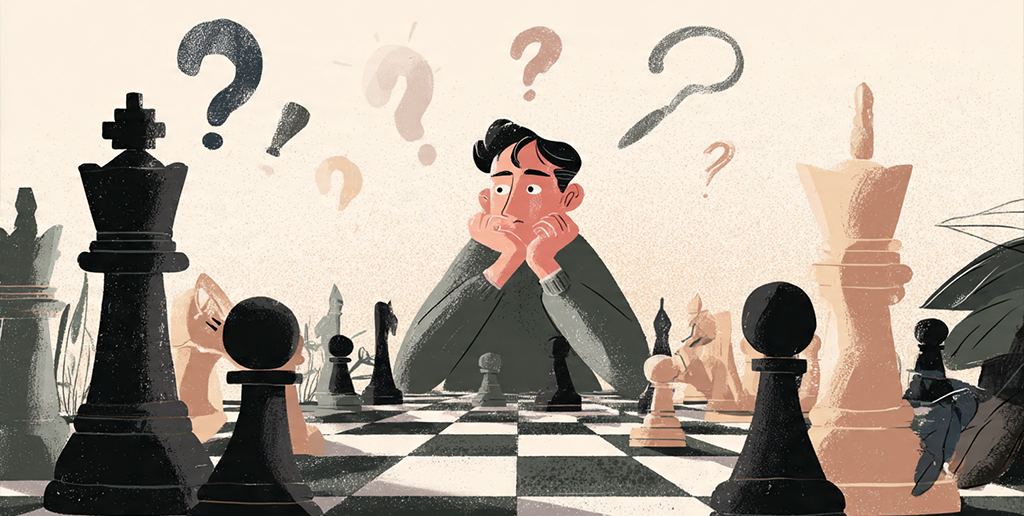
You've been here before. You hit 1480, grind your way to 1510, feel a spark of hope — then drop back to 1460 in three straight losses. You check your games. You look at the opening. You wonder if your Sicilian is leaking. You watch another YouTube video. Nothing changes.
Here's the uncomfortable truth: your openings are probably fine. Your endgame technique isn't what's killing you either. The real culprit — the one silently eating your rating points every single week — is your middlegame decision-making. And more specifically, it's a pattern of collapse that shows up again and again in players stuck between 1400 and 1600.
This article is going to get specific. We're going to look at what the data actually says about why players plateau at 1500, what types of middlegame mistakes are most common at this level, and what you can do — practically, today — to start breaking out.
The 1500 Plateau is Real, and It's Not Random
When researchers and chess coaches analyze large databases of online games — we're talking tens of thousands of games played by club-level players — a pattern becomes very clear. The 1400–1600 range is what some analysts call a "tactical awareness gap." Players in this range have learned enough to avoid simple one-move blunders most of the time. They know basic openings. They won't walk into a Scholar's Mate. But they haven't yet developed the middlegame intuition to handle complex, dynamic positions.
One analysis of over 15,000 games on Lichess found that players rated between 1400 and 1600 lost an average of 0.8 pawns of advantage per move during middlegame complications — nearly double the rate of players rated 1700 and above. That number is stunning when you think about it. You're not making one catastrophic blunder. You're slowly bleeding, move after move, in positions you don't fully understand.
The middlegame is where chess becomes genuinely hard. The opening has theory to guide you. The endgame has technique. But the middlegame? That's 20 to 30 moves of pure chess thinking, where you have to evaluate imbalances, find plans, calculate tactics, and manage your clock — all at the same time. If you're stuck at 1500, I'd bet a lot that this is exactly where your games are slipping away from you.
The Four Most Common Middlegame Collapse Patterns at 1500
Let's get into the specifics. After reviewing the patterns discussed by coaches like Dan Heisman, the Chessable research team, and analysis from large game databases, four middlegame mistakes show up disproportionately at the 1500 level:
This is the most common one. You finish your opening development, you've castled, and now... you don't know what to do. So you make a "useful" move. Then another. Then your opponent launches an attack and you're suddenly scrambling reactively.
The plan vacuum happens when players don't have a habit of asking the single most important middlegame question: "What is the most important feature of this position, and what should I be doing about it?" Is it a pawn majority? A weak square? An open file? A king safety imbalance? Players at 1500 often move pieces that look active without having a concrete goal in mind.
In a study of amateur games, positions where neither side had a clear tactical threat were won by the player with a clearer positional plan about 68% of the time at the 1700+ level — but only 51% of the time at the 1400–1600 level. Translation: strong players almost always have a plan. 1500-level players are basically coin-flipping.
You see your opponent's king looks slightly uncomfortable. One piece is pointing toward it. You feel the urge. You launch. Three moves later, your attack has stalled, you've given up material for nothing, and now your own king is exposed.
Premature attacking is the middle ground between being passive (never attacking) and being correctly aggressive (attacking with sufficient preparation). At 1500, players have learned that attacks can win games — which is progress from the 1200-level habit of just shuffling pieces around. But they haven't yet developed the judgment to know when an attack is genuinely there versus when it's wishful thinking.
The classic tell: an attack launched with only two pieces participating. Grandmaster Siegbert Tarrasch said it simply — "Before the endgame, the gods have placed the middlegame." Real attacks require coordination. If you can't bring at least three pieces to bear on the target before your opponent consolidates, you're probably not ready to attack yet.
You're deep in your own calculations. You've found what you think is a strong plan. You execute it. Then your opponent plays a move that takes apart everything, and you realize — they had a threat you never saw coming.
Dan Heisman coined the term "Hope Chess" for this phenomenon — playing moves and hoping your opponent doesn't find the best response. It's shockingly common at 1500. Research into game databases consistently shows that players in this range are about 40% more likely to overlook opponent threats when they are in the middle of executing their own plan.
The fix is actually simple, but it requires discipline. Before every single move you make, ask yourself: "What is my opponent threatening?" Not sometimes. Every move. Make it a reflex. This one habit alone has been credited by numerous coaches as a 50–100 point rating boost for players who genuinely adopt it.
Look at your last ten games. Find the ones you lost. Now look at your pieces — not the ones in the final position, but the ones during the critical middlegame moment. I'll guess that at least one of your bishops was doing nothing. A rook was still sitting on its starting square or stuck behind pawns. A knight was on the rim of the board.
Piece activity is the silent killer at 1500. While you were launching your premature kingside attack with two pieces, your opponent slowly activated all their pieces and then simply had more firepower when it mattered. Chess engines regularly highlight that 1400–1600 level players leave an average of one piece significantly underactive during the middlegame — and that underactive piece is often the difference between a winning position and a losing one.
Why Your Opening Study Won't Fix This
This is the part most stuck-at-1500 players don't want to hear. You've probably spent most of your improvement time on openings. You know your King's Indian lines up to move 12. You've memorized the main line of the Ruy Lopez. You can handle the Budapest Gambit. And you think that if you just knew one more line, you'd start winning more games.
But here's what the data says: a landmark study by researchers analyzing thousands of club-level games found that opening preparation accounts for less than 5% of the outcome variance in games between players rated under 1800. Five percent. The rest is decided in the middlegame and endgame — with the middlegame being the single biggest factor.
Opening study feels productive because it's concrete. You memorize a move, you know that move. There's a satisfying click when knowledge goes in. Middlegame improvement is harder because it requires building judgment, which is fuzzier and slower. But it's where your rating points are actually hiding.
What to Actually Do About It: A Practical Framework
Alright, enough diagnosis. Let's talk about what actually moves the needle for 1500-level players who want to improve their middlegame.
Step 1: Analyze Your Own Games — For Real This Time
Not a quick glance at what Stockfish says. Real analysis. After each loss, find the moment where the game turned. Usually there's a single moment — a "critical position" — where you had a decision to make and made the wrong one. Write down why you made that choice. Was it a plan vacuum? Tunnel vision? Premature attack? Label it. Track the patterns over 20 games. You'll find that you make the same type of mistake repeatedly, and knowing your specific weakness is the first step to fixing it.
Step 2: Do Positional Puzzles, Not Just Tactical Ones
Most players at 1500 do tactical puzzles. Good — tactics are important. But if you're only doing tactics, you're training your pattern recognition for positions that are already decided. You need to also train your judgment for positions that are not yet decided. Positional puzzles — "What's the best plan here?" questions — are what build middlegame intuition. Books like "Silman's Complete Endgame Course" and "How to Reassess Your Chess" are classics for a reason. The "Improve Your Chess" series by Jacob Aagaard is also excellent for this level.
Step 3: Use the 'Candidate Moves + Threats' Checklist Before Every Move
Before you move, go through a short mental checklist: What are my candidate moves? What is my opponent threatening? Which candidate move best responds to their threat while progressing my plan? This sounds slow, and at first it is. But this is exactly how stronger players think, and with practice it becomes second nature. If you're blitzing moves at a 10-minute time control without going through this process, you're essentially playing blunder roulette.
Step 4: Play Longer Time Controls
This is probably the most unpopular advice, but it's backed by every serious chess coach. If you are primarily playing 3-minute bullet or 5-minute blitz, you are not building middlegame thinking habits. You're building habits of moving fast. Play some 15+10 or 30-minute games. Give yourself time to actually think. Yes, you'll play fewer games. But the quality of chess improvement you get from one seriously considered 30-minute game is worth more than ten bullet games where you're just responding to patterns automatically.
A Real Example: The Collapse in 4 Moves
Let me walk you through what a typical 1500-level middlegame collapse actually looks like, without using a specific game. Imagine White has a slight positional advantage coming out of the opening — better piece development, slightly more central control. The position is not dramatic. There's no immediate tactic. This is precisely when the collapse begins.
Move 16: White doesn't know what to do in a quiet position, so plays a "developing" move with a piece that was already developed. This is the plan vacuum in action. The move isn't losing — it's just aimless.
Move 17: Black improves a piece and creates a subtle threat on the queenside. White doesn't notice — tunnel vision. White makes another non-committal move on the kingside.
Move 18: Black's threat materializes. White now has to react defensively, giving up the slight initiative they had. The position is now objectively equal, but psychologically White is on the back foot.
Move 19: White, trying to recapture the initiative, launches a premature attack on the kingside with only two pieces. Black's position is solid enough to weather it, and they counter with their now-active pieces. Three moves later, White's attack has failed, and one of their attacking pieces is now misplaced.
This is how 1500-level games actually get lost. Not in one dramatic blunder, but in a cascade of small decisions that each look reasonable in isolation but together constitute a complete strategic failure. A stronger player would have identified the right plan on move 16, noticed Black's threat on move 17, and never launched the unsound attack on move 19.
The Mindset Shift That Actually Changes Things
There's one more thing worth saying that goes beyond technique. Most 1500-level players approach improvement by asking "What do I need to learn?" But the more useful question is "What mistakes am I making?" These sound similar but they lead to very different behaviors.
"What do I need to learn" sends you to YouTube videos and opening courses and books you'll read halfway. "What mistakes am I making" sends you directly to your own games, where the answers specific to you are waiting.
Every 1500-level player who broke out of the plateau and reached 1700 or beyond did so not by suddenly learning something brand new, but by finally fixing the specific problems that were costing them games. Those problems, almost universally, lived in the middlegame.
The 1500 ceiling isn't a wall. It's a mirror. It's showing you exactly what you need to work on. The data is clear, the patterns are well-documented, and the path forward — while requiring real effort — is not mysterious. Fix your middlegame decision-making, and your rating will follow.
Final Thoughts: Stop Blaming Your Opening
The next time you lose a game at 1500, don't immediately run to review your opening moves. Go find move 15, 16, or 17 — the quiet moment just after the opening ended. Find the point where you didn't have a plan. Find where you missed your opponent's threat. Find where you launched an attack with two pieces against a solid position. That's where your game was lost.
Chess improvement at this level is less about knowing more and more about doing better. Better thinking process. Better habits. Better questions asked to yourself during the game. None of this is complicated — but all of it requires honest self-assessment and consistent practice.
You've been stuck at 1500 long enough. The middlegame is where your rating is hiding. Go find it.