
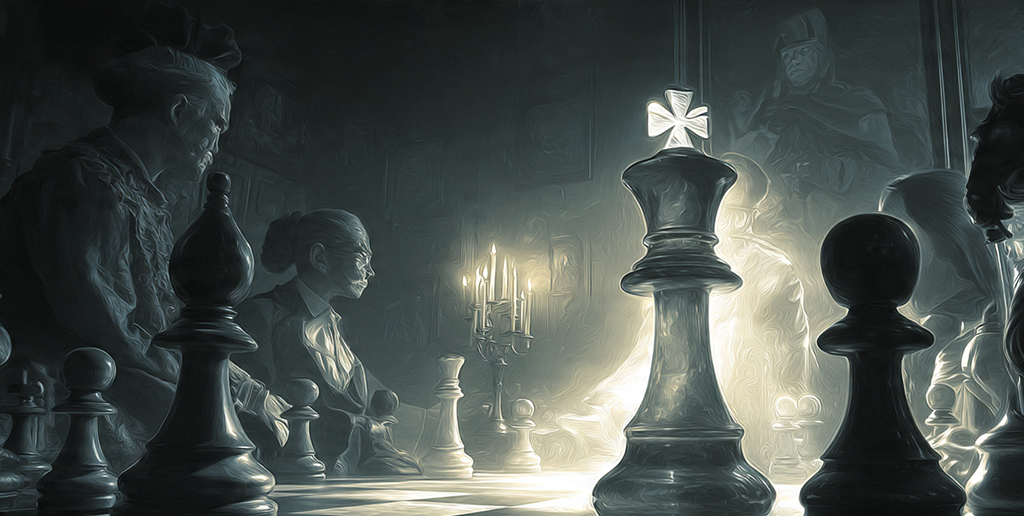
There's something almost romantic about the King's Gambit. White pushes a pawn to e4, Black mirrors it, and then White does something audacious — offering up a pawn on f4, daring Black to take it, essentially saying: Come on, fight me. It's the kind of opening that smells like candlelight and carved wooden pieces, like chess was meant to be played in dimly lit coffeehouses in the 1800s.
And in those coffeehouses, it thrived. For two hundred years, the King's Gambit was one of the most feared weapons on the chess board. Paul Morphy used it. Adolf Anderssen built immortal games with it. Even in the twentieth century, legends like Mikhail Tal and Boris Spassky wheeled it out from time to time to devastating effect.
But then, somewhere along the way, the grandmasters quietly put it down.
Today, if you watch a World Chess Championship match or any top-level classical game, you will almost never see the King's Gambit appear on the board. The elite players have moved on — to the Ruy Lopez, the Sicilian, the Catalan, or half a dozen quieter, more positional openings. The King's Gambit, for all its charm and fury, has become largely a curiosity at the highest levels of classical chess.
So what happened? Why did one of the most explosive and entertaining openings in chess history fall out of favor with the very best players in the world?
The answer is a fascinating mix of chess theory, computer analysis, and a fundamental shift in how the game is now understood.
What the King's Gambit Actually Is
Before we dig into why grandmasters abandoned it, it helps to understand what makes the King's Gambit so special — and so risky.
After 1.e4 e5 2.f4, White is offering a pawn. If Black takes it with 2...exf4, White gets a number of things in return: a strong pawn center after d4, open lines for the pieces, and attacking chances against Black's king. The idea is to play fast, develop quickly, and launch an assault before Black can get organized.
For centuries, this was considered great chess. The initiative was worth more than the pawn. A fast attack was worth the material. Chess was about seizing the game by the throat and never letting go.
The problem, which took a long time to fully appreciate, is that Black doesn't have to cooperate with this plan.
The Bobby Fischer Problem
In 1961, Bobby Fischer — then twenty years old and already one of the most dangerous players on the planet — published an article in American Chess Quarterly titled "A Bust to the King's Gambit." It was bold, aggressive, and very Fischer.
His argument was simple: with best play, Black can not only hold on to the extra pawn but also neutralize White's attacking chances and eventually win the endgame with the material advantage. His recommended line, 2...exf4 3.Nf3 d6, later known as the Fischer Defense, gave Black a solid and principled way to handle the opening.
Fischer's analysis wasn't perfect — nothing from that era is, by modern standards — but it was a shot across the bow. It signaled that the King's Gambit wasn't some magical attacking weapon but a concrete set of positions that could be studied, prepared, and neutralized.
The elite chess world took notice.
Over the following decades, theory on the King's Gambit kept developing, and what became clear was troubling for White: in many of the sharpest lines, Black could find ways to consolidate the extra pawn and reach positions where the extra material mattered more than White's activity.
The Computer Revolution Changed Everything
For most of chess history, opening theory was built on human intuition. Grandmasters would play a line, publish their analysis, other grandmasters would poke holes in it, and the theory would evolve slowly through decades of practice.
That process was completely upended by chess engines.
When programs like Fritz, Rybka, and later Stockfish and Leela Chess Zero began analyzing positions at depths humans couldn't dream of, the King's Gambit got subjected to a level of scrutiny it had never faced before. The engines didn't care about romantic attacking ideas. They didn't care that Anderssen had once produced a masterpiece with 2.f4. They simply calculated.
And what they found was consistent: in many lines of the King's Gambit, Black has sufficient resources to survive the attack and emerge with an advantage. Not always a big advantage. Not always an easy technical win. But an advantage nonetheless — which, at the grandmaster level, is enough.
The specific problem is what chess players call the "compensation question." When White sacrifices that pawn on move two, there needs to be enough compensation in activity, development, and attack to make up for the material. Engines showed that in many variations, this compensation falls just short. Black can accept the pawn, play carefully, and reach an endgame with an extra pawn and reasonable winning chances.
This doesn't mean White loses immediately. The King's Gambit remains incredibly dangerous in practice, especially at club level. But at the elite level, where both sides prepare deeply and play with near-perfect accuracy, "slightly worse" is a death sentence. Grandmasters don't voluntarily walk into positions where the computer says they're fighting for equality or slightly worse.
The Risk-Reward Problem at Classical Time Controls
Here's something important to understand about classical chess that makes the King's Gambit's decline even more logical: at slow time controls, preparation matters enormously.
In a classical game, players have hours to think. This means that opening preparation — the work done at home, often with an engine — plays a massive role in the outcome. If you show up to a classical game with a deeply analyzed line against the King's Gambit, your opponent can't just "wing it." They have to actually know the theory and navigate it correctly.
This favors Black enormously in the King's Gambit. Why? Because Black's task is actually simpler. Black grabs the pawn, plays solid developing moves, neutralizes the attack, and then lets the extra material do the work in the endgame. It's a concrete plan. It can be prepared and executed with precision.
White, on the other hand, is playing for chaos. The King's Gambit works best when Black makes small inaccuracies, when the position gets messy and complicated, when human calculation fails under pressure. In a blitz game, that happens all the time. In a four-hour classical game, against a well-prepared opponent with plenty of thinking time, those inaccuracies are much less likely.
This is why you still see the King's Gambit regularly in blitz and bullet chess. Magnus Carlsen has played it in speed games. Hikaru Nakamura has used it online. It's a fantastic weapon when your opponent doesn't have time to think carefully. But in classical chess, your opponent has all the time in the world to remember their preparation and find the right moves.
The Shift in Chess Philosophy
There's also a deeper philosophical shift that explains why the King's Gambit has fallen away.
Modern top-level chess is dominated by a fundamentally different approach to the game than what was popular in the 1800s and early 1900s. The romantic era of chess was all about attack and sacrifice, about winning by force with brilliant combinations. Material could be thrown away if the attack was good enough.
Contemporary grandmasters, shaped by decades of computer-assisted training, tend to think differently. The emphasis now is on control, on maintaining small positional advantages, on avoiding unnecessary risk. Players like Magnus Carlsen, Fabiano Caruana, and Ding Liren have built their success not on wild attacks but on an almost inhuman ability to squeeze advantages from positions that look equal.
In this environment, voluntarily giving up a pawn on move two — with no guaranteed compensation — is simply not how the best players think. The King's Gambit asks White to take on risk, to generate complications, and to hope that the resulting chaos favors them. Modern grandmasters prefer to build a position where they have a small but reliable edge, then slowly convert it. Less exciting, yes. But far more effective against the best players in the world.
Does That Mean the King's Gambit Is Bad?
Not at all. It's important not to confuse "rarely played at the elite level" with "refuted" or "bad."
The King's Gambit is still a completely playable opening. Below the grandmaster level, it's arguably one of the best openings you can learn, because it teaches you how to attack, how to generate pressure, and how to play actively. The positions that arise are lively and instructive, and most opponents at club level won't know the precise defensive lines well enough to neutralize White's initiative.
Even at the grandmaster level, the King's Gambit hasn't completely disappeared. It shows up occasionally as a surprise weapon, especially in must-win situations where a draw is useless. When you need a win and the opponent might not have prepared for it, the King's Gambit can be a smart choice. White gets a fighting position, and if Black is slightly off on their theory, the game can get dangerous quickly.
The great Russian-born player Alexander Morozevich built a portion of his career on wild, unconventional openings including sharp gambits. Nigel Short has played the King's Gambit at the top level. Even Garry Kasparov, one of the greatest players ever, experimented with it at points in his career, though he never made it a main weapon.
But these are exceptions, not the rule.
The Accepted vs. The Declined: A Different Story
One nuance worth mentioning is the distinction between the King's Gambit Accepted (where Black takes the pawn on f4) and the King's Gambit Declined (where Black refuses).
When Black declines the pawn — for example with 2...Bc5, the Classical Defense — the character of the game changes significantly. Black isn't trying to hold on to extra material; they're just developing normally and saying, "I'll meet your aggression with solid piece play." In these lines, White doesn't necessarily get the dangerous attacking positions they were hoping for. The position often simplifies into something fairly level.
This is another reason why elite players don't play the King's Gambit much. Against a strong, well-prepared opponent, Black can simply decline the whole adventure and steer into quieter waters where White's 2.f4 looks slightly odd rather than threatening.
What Replaced It?
If grandmasters stopped playing the King's Gambit, what did they turn to for attacking chances with the white pieces?
- The Spanish Opening (Ruy Lopez) became the dominant choice for elite players who want a slight long-term advantage and rich positional play. Lines like the Giuoco Piano and the Italian Game have seen a massive revival, providing White with central control without the pawn sacrifice.
- For sharper play, the English Opening and various Anti-Sicilian systems give White options to create complications without giving away material.
- When White wants to genuinely unbalance the position, gambits like the Scotch Gambit or the Evan's Gambit offer attacking chances while being slightly more positionally grounded than the King's Gambit.
The common thread is that modern opening choices tend to balance attacking potential with sound positional principles. Grandmasters want to create problems for their opponents without walking into a position where a well-prepared defense just works.
The Legacy Lives On
There's something a little sad about the King's Gambit's decline at the top level, if you're the kind of chess fan who loves history and romance and the idea of chess as a battle of courage and wit.
But it's also a testament to how deep the game is. Two hundred years of the best minds in chess playing the King's Gambit, and eventually theory evolved to the point where Black's defenses — armed with computer analysis and precise preparation — became strong enough to make the gambit genuinely risky at the elite level.
The King's Gambit didn't die because it's a bad opening. It faded from grandmaster practice because chess got harder. The defenses got better. The preparation got deeper. What worked by force in 1850 now requires more compensation than the position can provide.
In a way, that's the story of chess opening theory in miniature: every great attacking weapon eventually meets a great defense, and the game evolves. The King's Gambit had its era, and what an era it was.
For those of us who play at club level, the good news is that the King's Gambit remains wonderfully dangerous. Your opponents almost certainly haven't memorized the precise defensive lines. They haven't prepared with a computer. They might panic when you offer that pawn and try to hold on to the material while also defending against your attack.
In those games, the King's Gambit can still feel exactly like it did in the coffeehouses of Vienna two centuries ago — wild, brilliant, and alive.
Final Thoughts
The King's Gambit stopped appearing in elite classical games not because it was refuted in any simple or clean sense, but because the standards of the game changed around it. Modern preparation, computer analysis, and a more positional, risk-averse approach to opening theory made voluntarily sacrificing a pawn on move two a harder proposition to justify when both players are playing at near-perfect levels.
At the same time, the opening retains real value at every other level of the game, and its legacy in chess history is secure. Some of the most beautiful games ever played began with 1.e4 e5 2.f4.
And occasionally — just occasionally — when a grandmaster sits down in a must-win game and decides the moment calls for something audacious, that pawn still slides to f4, and the spirit of Anderssen and Morphy is briefly, brilliantly alive again.