
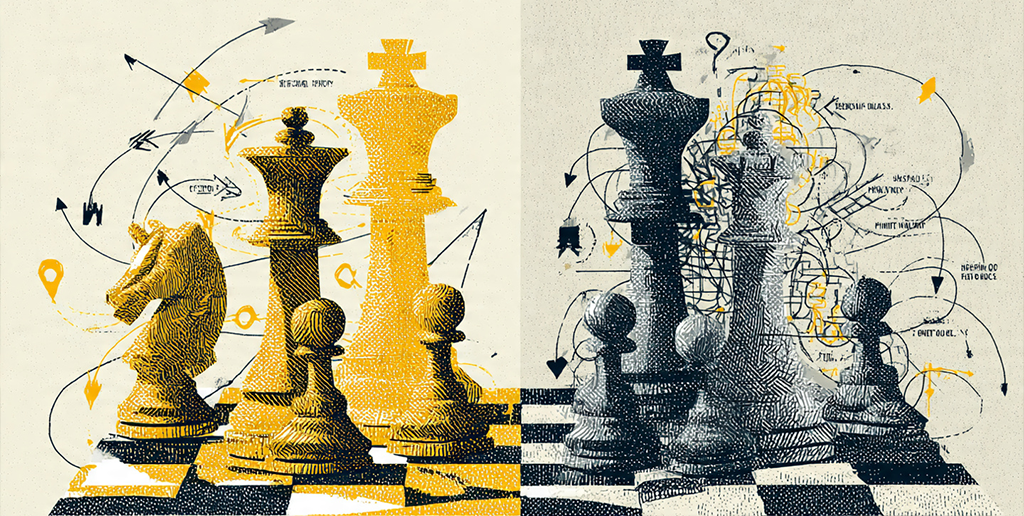
You've studied your openings. You know the Italian Game, maybe a bit of the Sicilian Defense. You can develop your pieces, castle early, and avoid the obvious blunders in the first ten moves. You feel good about your start — and then, somewhere around move 15 to 20, everything falls apart.
Your opponent starts pressing. You're not sure where to put your rook. You shuffle a piece back and forth hoping something becomes clear. And then — one slightly passive move at a time — you slowly drift into a lost position without ever knowing exactly when the game slipped away.
Sound familiar? Welcome to what coaches and experienced players quietly call the "Move 20 Wall." It's the most common place club players — people rated anywhere from 800 to 1600 — lose games that didn't need to be lost. Not from blunders. Not from missed tactics. But from having absolutely no plan once the opening is done.
What Is the Move 20 Wall, Exactly?
Chess has three broad phases: the opening, the middlegame, and the endgame. Most beginners and intermediate players spend almost all of their study time on openings. They memorize lines, watch YouTube videos about the first 10 moves, and feel confident walking into a game.
But here's the uncomfortable truth: openings end. Somewhere around move 15 to 20, you run out of memorized lines. The position is unique. The engine prep is over. And now you actually have to play chess.
This transition — from the structured comfort of opening theory to the wild open waters of the middlegame — is the Move 20 Wall. And for most club players, it's where the real game begins. Unfortunately, most of them are completely unprepared for it.
It's not that they suddenly become bad players. It's that they never developed the habit of asking the right question at this stage of the game: "What is my plan right now?"
Why Does This Happen to So Many Club Players?
Let's be honest about how most casual players learn chess. They watch some opening tutorials. They play a bunch of online blitz games. They lose to the same traps a few times and look them up. Gradually, they build a decent enough foundation in the opening phase.
But the middlegame is messier, harder to memorize, and less satisfying to study. There's no set of "10 rules" that applies universally. There's no clean opening tree to follow. The middlegame demands independent thinking — evaluation, planning, calculation — and those skills take time and deliberate effort to build.
The result? Most players have a gap in their chess education that sits right at the transition from opening to middlegame. They arrive at move 18 or 20 with a reasonable position and genuinely no idea what to do next.
Compounding the problem is clock pressure. In blitz and rapid games, players don't have the luxury of thinking deeply at every move. So they default to what feels "safe" or "natural" — which often means aimless piece shuffling, waiting for the opponent to make a mistake, or making moves that look active without actually being useful.
The Symptoms of Hitting the Wall
How do you know if the Move 20 Wall is consistently costing you games? Here are the signs most players recognize immediately:
- You finish development and then pause. Once your pieces are out and you've castled, you sit there wondering "okay, now what?" You make a few moves that seem reasonable but don't connect to any larger goal.
- Your pieces get in each other's way. Without a plan, pieces often end up on squares where they block each other. Your bishops are passive. Your rooks are stuck behind pawns. The coordination breaks down.
- You react instead of play. Instead of pursuing your own agenda, you spend the whole middlegame responding to what your opponent does. You're always defending or adjusting. You never feel like you're driving the game.
- You drift into bad positions slowly. Your losses don't come from a single blunder — they come from a dozen small concessions that add up. By move 30, your position is just worse, and you're not entirely sure why.
- You get outplayed by people with similar tactics knowledge. This one hurts. You can calculate combinations just as well as your opponent, but they keep winning. That's because they have a plan and you don't. Tactics without strategy just spends your pieces without purpose.
The Real Cause: You Don't Have a Middlegame Framework
The root of the Move 20 Wall isn't laziness or lack of talent. It's the absence of a structured way to evaluate and plan in the middlegame. Strong players — even if they can't articulate it — have internalized a kind of mental checklist they run through at every important moment in the game.
They ask: Where is the tension in this position? What imbalances exist? Who has the better minor pieces? Where are the weaknesses on both sides? What pawn breaks are possible? Which piece is misplaced and needs to be improved?
Club players generally don't run this checklist. They look at the board, they look for something "active" or "forcing," and when nothing obvious appears, they move the piece that seems safest. That's not planning — that's improvisation. And improvisation in chess usually loses to preparation.
Breaking Through: A Simple Middlegame Planning System
The good news is that you don't need to become a grandmaster to clear the Move 20 Wall. You just need a simple framework to fall back on when the opening ends and you have to figure out what to do next. Here's one that works for players at every level below 1800.
Before anything else, look at the pawns. Are they locked (no pawn exchanges left) or fluid (tension remains)? Is there a clear pawn majority on one side? Are there open files or half-open files? Isolated pawns? Passed pawns? The pawn structure tells you where the game is going to be fought — and therefore where your pieces should go.
If your pawn majority is on the queenside, your plan is probably to advance it and create a passed pawn. If your opponent has an isolated queen's pawn, your plan is probably to blockade and attack it. The pawns give you the roadmap — you just need to read it.
Step 2: Identify the ImbalancesEvery chess position has imbalances — factors that differ between the two sides. These are things like: bishop vs. knight, open vs. closed position, strong outpost vs. weak square, space advantage vs. flexibility. Your job is to figure out which imbalances favor you, and then build a plan that exploits them.
For example, if you have a knight and your opponent has a bishop, you want the position to be closed with fixed pawns — because bishops hate closed positions. If you have two bishops, you want to open the position up. These simple ideas translate directly into concrete plans.
Step 3: Find the Worst Piece on the BoardThis is one of the most practical and immediately applicable tips in all of chess: at any given moment, find your worst-placed piece — the one that's passive, misplaced, or doing nothing — and improve it. Move it to a better square. Open a file for it. Give it purpose.
This sounds too simple to matter. But if you actually do this consistently, you'll be surprised how often "improving the worst piece" is the right plan. It keeps your position coordinated, builds long-term pressure, and avoids the drift that kills most club players' games.
Step 4: Create or Exploit a WeaknessThe ultimate goal in the middlegame is to create a weakness in your opponent's position and then attack it with multiple pieces. A weakness can be a pawn that's isolated or doubled, a square that your opponent can't defend with a pawn, or a king that's exposed.
If you don't see a weakness yet, your plan is to create one — usually through pawn advances that force your opponent to either accept a structural concession or allow you a strong outpost. This is what "playing for position" looks like at the club level.
The Study Fix: What to Actually Practice
Knowing the framework is one thing. Building the instinct is another. Here's how to actually train your middlegame thinking so that it becomes natural by the time you're over the Move 20 Wall.
- Play longer time controls. Blitz is fun, but it teaches you to react, not to plan. Even 15+10 rapid games force you to sit down and think. One good 30-minute game where you tried to plan is worth ten 3-minute blitz games where you just moved quickly.
- Analyze your own games — but specifically around moves 15 to 25. Use an engine, but before you turn it on, try to write down what you thought your plan was at each move. Then compare. You'll quickly see where you lost the thread.
- Study annotated master games, not just puzzles. Tactical puzzles train calculation. But understanding how strong players think in the middlegame requires watching them play full games and reading explanations of why they chose each move. Books like "My System" by Nimzowitsch or "Chess Strategy for Club Players" by Herman Grooten are classics for a reason.
- Practice with a single question. After every move in your practice games, ask yourself: "What is my plan for the next three to five moves?" You don't need to be right. You just need to have an answer. The habit of asking the question is what breaks through the wall.
A Quick Example: The Wall in Action
Imagine a game where White has played the London System. It's move 18. Both sides have castled. White has a solid pawn structure with a pawn on d4, and pieces developed reasonably. Black has a French-style setup with a pawn on e6, a bishop locked behind it, and a knight on f6.
The club player with White looks at the position and sees... nothing. No immediate tactic. No open file. Nothing forcing. So they make a waiting move — maybe shuffling a rook from f1 to e1, not because there's a specific plan but because it seems reasonable.
What should White actually do? Apply the framework. Pawn structure: White has more central space. Imbalance: Black's bishop on c8 is terrible — locked in by its own pawns. Worst piece: that bishop. Plan: advance pawns to restrict Black even further, place pieces on strong squares, and wait for Black's position to become completely passive before converting.
That's not a flashy plan. It won't win in five moves. But it's a real plan — one that gives the position direction and keeps White improving while Black struggles. That's what playing through the Move 20 Wall looks like.
The Mindset Shift That Changes Everything
Beyond technique, there's a mindset shift that separates players who break through the wall from those who stay stuck. It's the shift from playing chess to playing your chess.
Most club players are passive in the middlegame. They wait for something to happen. They hope their opponent makes a mistake. They move pieces reactively rather than proactively. This passivity is the wall.
The players who clear the wall understand that chess is a game of initiative. You have to create your own threats, your own pressure, your own problems for the opponent to solve. Even when the position feels quiet, you should be asking: How do I make this position worse for them? What do they not want to see happen? And then — do that.
This doesn't mean playing recklessly. It means playing purposefully. Every move should serve a function. And if you can't explain what a move is for, that's a signal to think more before you play it.
Final Thoughts: The Wall Is Climbable
The Move 20 Wall stops most club players not because the middlegame is impossibly difficult, but because nobody told them it was coming. Opening theory feels manageable — there are books, videos, and memorizable lines. The middlegame feels like chaos.
But it isn't chaos. It's a different kind of structure — one built on pawn structures, imbalances, piece activity, and long-term plans. Once you understand that the middlegame has its own logic, the wall stops being a wall and starts being a doorway.
Start small. After every game you play, go back to move 18 or 20 and ask yourself: what was my plan here? Was there one? If not — that's your homework. Not more opening lines. Not more endgame technique. Just: what was my plan, and how could it have been better?
Do that consistently, and within a few months you'll be one of those players who doesn't just survive the middlegame — but actually enjoys it. That's where chess gets interesting. And that's exactly where most of your opponents are still getting lost.