
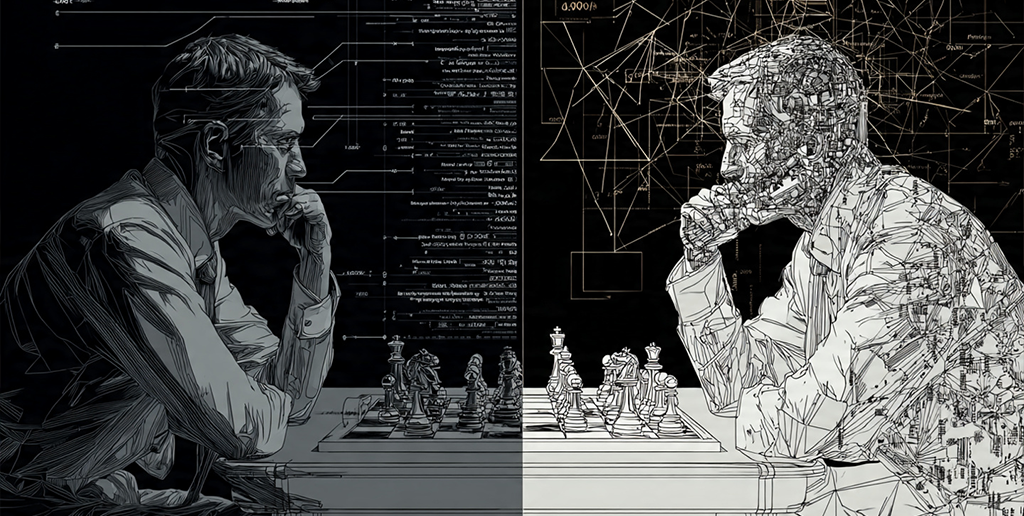
Chess Improvement | Engine Analysis | Practical Tips
You've just finished a game. You open up Stockfish or Leela, and right away the engine slaps you with a move you never even considered. Something wild. Maybe it involves a sacrifice. Maybe the piece just sits there on a weird square doing what looks like absolutely nothing for ten moves before it suddenly becomes the hero of the position.
You stare at it. You can't see why it works. The engine's evaluation bar shoots up, but no matter how hard you look, the logic refuses to click.
Here's the honest truth: that move might just be too complicated for a human to play — at least reliably, over the board, under time pressure, game after game. And that's perfectly okay. But it does raise a really important question that most chess players never stop to ask: how do you actually tell the difference between a move that's complicated but learnable, and one that's engine-only territory?
That's exactly what this article is about. Whether you're a club player trying to improve your opening repertoire, or an ambitious amateur reviewing your games seriously, this guide will help you filter engine suggestions in a way that's actually useful for your chess.
First, Understand Why Engines Think Differently Than Humans
Before anything else, it helps to understand the fundamental difference between how a chess engine evaluates a position and how a human does.
Engines don't get tired. They don't feel anxiety in a bad position. They don't get confused by tactical noise. A modern engine like Stockfish 17 can search millions of positions per second and calculate variations 30 or 40 moves deep without breaking a sweat. More importantly, it has zero psychological reaction to what it sees. Whether a position looks scary, chaotic, or counterintuitive means absolutely nothing to it.
Humans, on the other hand, rely heavily on pattern recognition, intuition, and practical heuristics — shortcuts that usually work but sometimes fail us. We make decisions based on what we can visualize, and we're limited by our calculation depth, our concentration, and yes, the clock.
This is why some engine moves are genuinely unplayable for humans — not because they're bad moves, but because playing them correctly requires a depth of calculation and precision that no human can consistently maintain at the board.
Sign #1: The Move Has No Clear Immediate Purpose
One of the biggest red flags that a move is too engine-like is when you genuinely cannot explain what it's doing in plain chess language.
Good human moves almost always have a clear, communicable idea behind them. "I'm putting pressure on the d-file." "I'm preventing that knight from coming to f5." "I'm creating a passed pawn." Even complicated sacrifices usually have an idea you can express in words, even if the follow-up requires some calculation.
Engine moves, by contrast, sometimes look like they're doing nothing — or doing five things at once that only make sense fifteen moves later. The move might be "prophylactic" in a way that requires seeing deeply into a specific long variation that never materializes unless your opponent plays the exact right sequence of moves.
Ask yourself this: can you explain this move to a friend in one or two sentences? If you're struggling to articulate what the move does, that's a sign it may belong in the engine's world, not yours.
Sign #2: The Move Only Works Against Precise Opponent Responses
This one is subtle but really important for practical chess. Some engine moves are technically best, but they only maintain their advantage if your opponent also plays perfectly in response — and they rely on your opponent making a specific mistake to become truly devastating.
In a computer vs. computer match, that's fine. The engine on the other side will play precisely. But in a human game, your opponent might not take that "bait" move. They might play something else entirely. Now you're in a messy position that you drifted into trusting a line you don't fully understand.
A practical test: look at the engine's tree of variations after the suggested move. If 70–80% of the branches require exact follow-up play from you over the next several moves, that's a sign the move is high-maintenance. Engine moves that are good for humans tend to maintain their advantage across a wide variety of opponent responses, not just one narrow line.
This principle is sometimes called "move robustness" — and it's one of the most underrated concepts in practical chess preparation.
Sign #3: The Evaluation Jumps Dramatically Based on Depth
Here's a little trick most club players don't know: watch how a position's evaluation changes as you increase the engine's search depth.
If at depth 15 the engine says the move is +2.5 (clearly winning), but at depth 10 it was showing +0.3 (equal), that's a massive flag. It means the advantage only becomes clear after very deep calculation — the kind of calculation a human cannot reliably reproduce at the board.
On the other hand, if a move shows roughly +1.5 at depth 10, +1.6 at depth 15, and +1.7 at depth 20, that's a much more stable evaluation. It means the advantage is based on something concrete and recognizable — not some deep tactical trick that only becomes visible after 25 moves of forced play.
Moves whose evaluations are "depth-sensitive" tend to be engine-only territory. Moves with stable evaluations across depths are usually more human-friendly.
Sign #4: The Move Involves Counterintuitive Material Imbalances
Piece sacrifices are a beautiful part of chess, and humans have played brilliant sacrificial attacks throughout the history of the game. So it's not that sacrifices are automatically too complicated — it's about the nature of the compensation.
When an engine suggests giving up material, ask yourself: what is the compensation? If the answer is something concrete — "I get a direct mating attack," "I win back the piece in three moves," or "I get a clearly dominant pawn structure" — that's a human-playable sacrifice. The compensation is something you can see and feel.
But if the compensation is something like "my pieces are more active, and that slight positional edge compounds over the next 20 moves," that's much harder. Engines are exceptional at holding and converting these long-term positional advantages. Most amateurs are not. If you can't clearly articulate what you're getting for the material you're giving up, the move is likely beyond reliable human play.
A useful rule of thumb: if Magnus Carlsen or another elite grandmaster would probably find this sacrifice over the board, it's likely learnable. If even top humans miss it in their games, take that as a hint.
Sign #5: You Can't Find a "Next Best" Human Move That's Close in Value
Open up your engine's multi-PV analysis — that's the setting where the engine shows you the top 3, 4, or 5 candidate moves simultaneously. This is incredibly revealing.
If the engine's first choice is rated +2.0, and the second choice is +1.8, and the third is +1.6, then you've got options. There's a range of reasonable human moves here. You might not find the absolute best move, but you can play something good.
But if the engine's top move is +2.0, the second is +0.2, and the third is -0.5, you're looking at a position with a single, razor-thin "only move" at the top. Miss it, and the position collapses. This kind of position is extremely dangerous for humans, because it punishes every deviation from the perfect path.
Practical chess is about finding good moves consistently. Positions with a huge gap between first and second-best moves are engine territory — avoid walking into them if you can.
Sign #6: The Move Requires Calculating Long, Forced Variations
There's a big difference between a move that's complicated because it creates rich, interesting play (which humans can handle) and a move that's complicated because it requires you to calculate a 15-move forced sequence correctly or everything falls apart.
The latter is what we're talking about here. Some engine moves begin a forced tactical sequence that only works if you can see the whole thing clearly from move one. Skip even one step, and your position unravels.
Ask yourself: how many forced moves follow from this suggestion? If the engine's principal variation (PV line) shows 8+ forced moves in a row, with your opponent having very few alternatives, that's a long calculation you need to get right every time. Elite grandmasters can sometimes handle this. Club players and intermediate players usually cannot — especially in time pressure.
The shorter the forced sequence required to justify a move, the more human-friendly it is. The longer it is, the more it belongs to the engines.
What to Do Instead: Finding the "Best Human Move"
Okay, so you've identified that the engine suggestion is beyond you. What now?
This is where your post-game review becomes genuinely useful for improvement. Instead of just noting what the engine played and moving on, dig into the position more deliberately. Try to find the best move you could have realistically found at the board, given your level and the clock situation.
- What was the best move I could have calculated confidently in 2–3 minutes?
- Among the top engine moves, which one has the most stable evaluation across depths?
- Which move can I explain in plain language with a clear idea behind it?
- Which move maintains a decent advantage even if I make a slight follow-up inaccuracy?
This process is sometimes called finding the "human best move" rather than the computer best move. It's a skill in itself, and developing it will help you improve much faster than blindly memorizing engine lines you can't really understand.
A Special Note on Openings and Engine Preparation
This distinction matters enormously when you're building an opening repertoire.
A lot of club players fall into the trap of adopting razor-sharp opening lines because the engine rates them very highly. They memorize the moves at home, and things go fine until their opponent deviates on move 9 instead of move 12. Suddenly they're in an unfamiliar position that requires the same precise engine-level play — and they're lost.
For most players below 2000, a practical, human-friendly opening is far more valuable than the objectively sharpest engine-approved line. Look for openings and variations where:
- The plans are clear and repeatable regardless of what your opponent does
- The key ideas can be expressed in terms of pawn structures and piece activity, not 20-move forced lines
- A slight deviation by either side doesn't cause an immediate collapse
Engines are a fantastic research tool, but they should serve your chess — not the other way around. If you're picking moves and lines based purely on what the engine likes, you may end up with a repertoire that looks good on paper but crumbles the moment you're sitting at the board without the computer to guide you.
Using Engines Intelligently: The Right Mindset for Review
Here's a shift in mindset that will completely change how useful your engine analysis sessions are: stop using the engine to find what the right move was, and start using it to understand why positions work the way they do.
When you see an engine suggestion, don't just look at the move. Look at what it's preventing. What it's preparing. What the resulting pawn structure looks like 10 moves down the line. Try to find the human logic behind the computer's choice, even if the specific move itself isn't one you'd play.
Ask: "Even if I can't play this exact move, what principle does it illustrate?" Maybe the engine is emphasizing the importance of centralizing the knight before launching a kingside attack. Maybe it's showing you that the rook on the seventh rank is more valuable than the bishop you were about to recapture. These lessons are transferable, even when the specific engine move is not.
Great chess coaches often suggest spending more time on positions than on moves during analysis. The engine tells you what happened — your job is to figure out why.
- No clear immediate purpose. You can't explain what the move does in plain language.
- Works only against precise opponent play. The advantage evaporates if your opponent finds an alternative.
- Depth-sensitive evaluation. The engine's score changes dramatically as you increase search depth.
- Unclear material compensation. A sacrifice whose payoff is purely positional and long-term.
- Huge gap between best and second-best move. Multi-PV analysis shows only one reasonable option.
- Requires long forced calculation. The correct follow-up is a 10+ move forced line that must be seen in full.
Final Thoughts
Chess engines are extraordinary tools, and every serious player should use them for analysis. But they are tools — not teachers in the traditional sense. They don't know what your level is. They don't know how much time you had on the clock. They don't care if the winning move requires a calculation sequence that only a handful of humans in history could find reliably.
Learning to filter engine suggestions — to distinguish between moves that will genuinely improve your play and moves that exist only in the realm of silicon perfection — is one of the most important skills you can develop as an improving chess player.
The next time you're doing post-game analysis and the engine shows you something that makes your head spin, don't just dismiss it and don't blindly accept it either. Run it through the checklist in this article. Ask the hard questions. Find the human lesson hiding inside the machine's suggestion.
That's how engines make you a better chess player — not by showing you moves to memorize, but by revealing the deep logic of the game, one position at a time.
Now go review your last game — but this time, with a critical eye.