
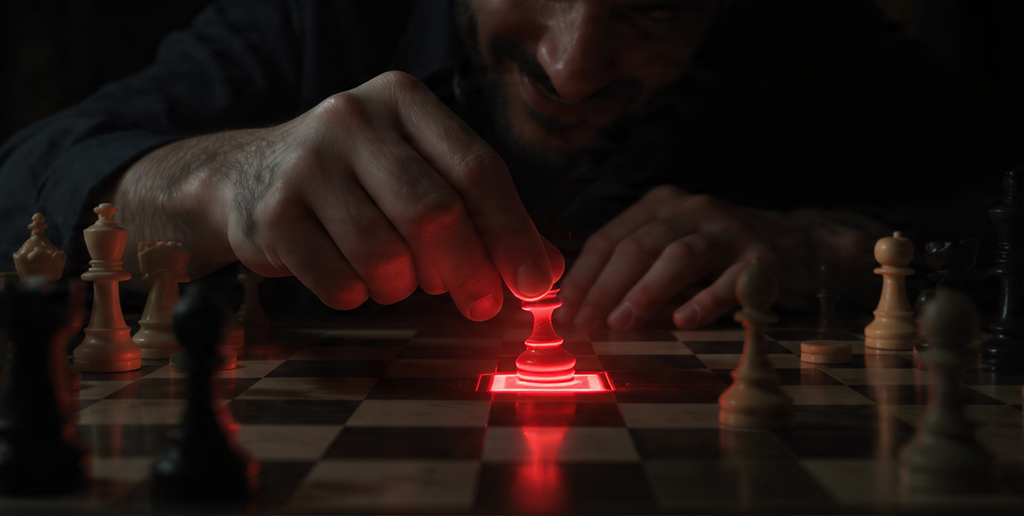
You set up what looks like a clever little trap. Your opponent walks right into it — or so you hope. Sound familiar? This habit has a name, and it's quietly keeping thousands of players stuck below their true potential.
Let me tell you about a game I watched at a local club a few months ago. White had built a decent position — pieces developed, king safely castled, good pawn structure. Then, instead of finding the best move, the player spent three consecutive turns nudging a bishop back and forth, essentially waiting for the opponent to blunder into a cheap fork.
The opponent didn't blunder. They just played normally. And White, who had spent those tempos doing nothing useful, found himself in a losing endgame twenty moves later, shaking his head.
What that player was doing has a name: Hope Chess. And if you've ever played chess — even casually — you've almost certainly done it too.
What Exactly Is Hope Chess?
The term was popularized by coach and author Dan Heisman. Hope Chess is when you make a move without fully calculating whether your opponent can punish it. Instead of asking, "Can my opponent refute this?" you just play the move and hope they don't find the right response.
One-move traps are the most common and most damaging form of this habit. You set up a position that looks threatening, but only works if your opponent makes one specific mistake. If they don't? Your plan collapses — and worse, you've often wasted crucial moves or weakened your position in the process.
This is different from deliberately building long-term pressure, or playing a move that has genuine threats along with good positional value. Hope Chess is specifically about making moves whose entire purpose depends on your opponent being oblivious.
Why Does It Feel So Good in the Moment?
Here's the honest truth: setting traps isn't irrational. At certain levels, it works. A lot. When you're playing someone who is new, or even moderately experienced, people miss threats all the time. Getting a piece for free or delivering a quick checkmate is enormously satisfying.
The problem is that this success teaches the wrong lesson. Your brain logs it as: "Clever trap = win." It doesn't log: "Opponent made a beginner mistake, and I happened to be there to punish it."
So you do it again. And again. And for a while, it keeps working — until you start playing people who simply don't blunder at move 8. Against those players, your trap-setting leaves you a tempo or two behind, with a compromised structure and no real plan. That's when the losses start piling up and you can't figure out why.
"The trap-setter stops thinking about chess and starts thinking about the opponent's mistakes. That's the moment development stalls."
The Real Cost: What You're Giving Up
Every move in chess has an opportunity cost. When you spend a move setting a one-move trap, you are choosing that move over every other possible move — including the objectively best one. Let's break down exactly what you sacrifice.
1. Development Time (Tempo)
In the opening and early middlegame, tempo is everything. Each move should either develop a piece, contest the center, or improve your king's safety. When you maneuver a piece to a passive square just to set a trap, you're gifting the opponent free development. They get to complete their setup while you're busy hoping.
Strong players talk about "being a tempo down" as if it's a measurable disadvantage — and it is. Studies of grandmaster games consistently show that a one-tempo deficit in open positions can be enough to lose a game at the highest levels. You're giving that away for free.
2. Calculation Habit
Real chess improvement happens when you train your brain to calculate correctly — to look two, three, four moves ahead and evaluate positions honestly. Hope Chess short-circuits that process entirely. Instead of calculating, you're gambling. Your calculation "muscle" atrophies because you're not using it.
Players who rely on traps often hit a ceiling around 1000–1200 ELO and genuinely struggle to understand why. The answer is almost always the same: they never trained their calculation. They won games by opponent mistakes, not by better thinking.
3. Positional Understanding
Traps are tactical. Chess mastery is mostly strategic. When you obsess over one-move tricks, you stop asking deeper questions: Where should my pieces go? What weaknesses does the opponent have? What's my long-term plan?
These are the questions that turn a 1200 player into a 1600 player. They require a completely different mindset from trap-setting. And the longer you spend in trap-mode, the harder it becomes to shift into strategic thinking.
4. Emotional Resilience
There's a psychological dimension here too. When your entire game plan depends on the opponent blundering, and they don't blunder — you suddenly have no plan at all. That moment of "oh no, what do I do now?" is deeply unsettling. Many trap-reliant players tilt badly at this point, rushing their moves or making desperate counter-traps.
In contrast, players who focus on sound development almost always have a plan. Even if the position isn't perfect, they know what to do next. That clarity is calming.
The Most Common One-Move Traps (And What to Do Instead)
Let's look at the patterns most often abused by developing players, and what good play looks like in each case.
- The Scholar's Mate Obsession: Every beginner tries Scholar's Mate — the four-move checkmate with Qh5 and Bc4. It works occasionally. But experienced players have known the defense for centuries. The real problem isn't the attempt itself; it's players who, when it fails, spend the next five moves retreating that misplaced queen while Black develops freely.
Better approach: use those early queen moves to learn about center control instead. Play 1.e4 and develop your minor pieces first. Understand why the center matters rather than why Qh5 looks scary. - The Poisoned Pawn Gambles: Setting up a pawn that looks free to take, but actually drops a piece if captured. These can be legitimate traps — grandmasters use them too. The difference is that grandmasters only set them in positions that are already good. If the opponent doesn't take the pawn, the position is still solid.
Hope Chess version: sacrificing structural integrity to set the pawn, then having no backup plan if it's declined. - The Back-Rank Shuffle: Moving pieces back and forth in the middlegame, waiting for the opponent to walk into a fork or pin. This is pure hope chess. Every shuffle is a wasted move. If you find yourself moving a piece to the same square twice in a row without any concrete reason, stop and ask: What am I actually trying to accomplish?
How Strong Players Use Traps Correctly
This is important: good players set traps too. The difference is how and when.
A grandmaster sets a trap by first finding the objectively best move, and then noticing that this best move also happens to contain a hidden threat the opponent might miss. The trap is a bonus, not the purpose. If the opponent sees through it, the grandmaster is still in a great position because the move was good on its own terms.
Garry Kasparov was a master of this. He would build enormous pressure, and within that pressure, lay small tactical mines. But none of those mines required the opponent to blunder for Kasparov's position to be winning. He was winning anyway.
That's the standard to aim for: play moves that are good whether or not the opponent finds your threat.
A Simple Framework to Break the Habit
If you recognize yourself in this article, here's a practical process to start correcting it today. It doesn't require a coach or expensive software — just honesty with yourself during games.
- Name your candidate moves. Before playing anything, find at least two or three candidate moves. This forces your brain out of "one obvious trap" mode and into genuine calculation.
- Apply the opponent's best reply test. For each candidate, ask: "What's the strongest thing my opponent can do?" Play that response in your head. Does your position hold up? Does your plan still work?
- Choose the move that's good regardless. Pick the move that maintains or improves your position whether the opponent finds the refutation or not. If a move only works if the opponent blunders, it doesn't qualify.
- Review your games with this lens. After the game, identify every move you made that depended on opponent error. Count them. You'll probably be surprised how many there are — and that awareness is the beginning of change.
- Study endgames deliberately. Endgame study is the fastest cure for Hope Chess. Endgames are pure calculation and technique — there are no traps. Regular endgame practice rewires your brain to think concretely, which then improves your middlegame calculation too.
The Mindset Shift That Changes Everything
At its core, Hope Chess is a mindset problem, not a technique problem. It's rooted in a belief that chess is about catching your opponent, not about building a superior position. That belief needs to be replaced.
Start thinking of chess not as a game of traps, but as a game of problems and solutions. Your job is to solve the position — to find what the pieces on the board actually need. Sometimes that means setting a trap. More often, it means developing a knight, contesting an open file, or improving your worst-placed piece.
When you adopt this framework, something interesting happens: you start seeing your opponent's threats more clearly too. Because you're now asking "what does the position need?" on both sides of the board, you stop being blindsided by tactics you missed because you were too busy hoping.
"Real chess improvement is about taking responsibility for your own moves — not waiting for a gift from the opponent."
What to Expect When You Make the Change
Fair warning: when you first stop playing hope chess, you might lose more games in the short term. This is normal. You're giving up a weapon that worked cheaply before, and the replacement habits — calculation, strategic thinking, positional play — take time to develop.
Think of it like switching from a sugar rush to eating properly. The sugar high felt good. Real nutrition feels slower at first. But after a few weeks, the difference is enormous.
Most players who consciously break the hope chess habit and replace it with sound development principles see their rating climb meaningfully within three to six months. Not because they suddenly learned secret openings, but because they stopped gifting games away with passive, trap-dependent moves.
More importantly, they start enjoying chess more. When you're playing with a real plan, wins feel earned. You understand why you won. And when you lose, you can identify exactly what went wrong — which is the fastest possible way to improve.
Final Thoughts
Hope Chess is seductive. It promises shortcuts. It rewards you just often enough to keep you hooked. And it quietly caps your development at a level well below where your natural talent could take you.
The antidote isn't complicated: play moves that are good on their own merits, calculate your opponent's best response before committing, and trust that a superior position will create its own opportunities — including tactical ones — naturally.
Chess has been played for fifteen hundred years. The players who left their mark on it weren't the ones who set the cleverest traps. They were the ones who built the best positions, move by patient move.
The board doesn't reward hope. It rewards honest thinking.